
Bringing to you, the technique that makes me want to question if my neck and shoulders are more important than contributions to science- RT-qPCR (P.S. I’d still do it for the results).
Ideally, I should rename the title as “mRNA” but one can probably identify different types of RNA if one has the right components.
What is RNA?
RNA or ribonucleic acid is a molecule, very similar to DNA, that is the joining link between DNA and proteins. It is also the genetic material of some viruses, just like DNA is for humans. SARS-CoV-2 and rhinovirus, that causes common cold, have RNA as their genetic material.
Basically, DNA is your original copy. DNA has the information to make up everything in the cell, and further, the body. In order to prevent damaging the original copy, DNA, the cells copy parts of it into RNA which then makes up proteins and other cellular molecules. In this way, the original copy is conserved and RNA, acts as an intermediate “copy.”
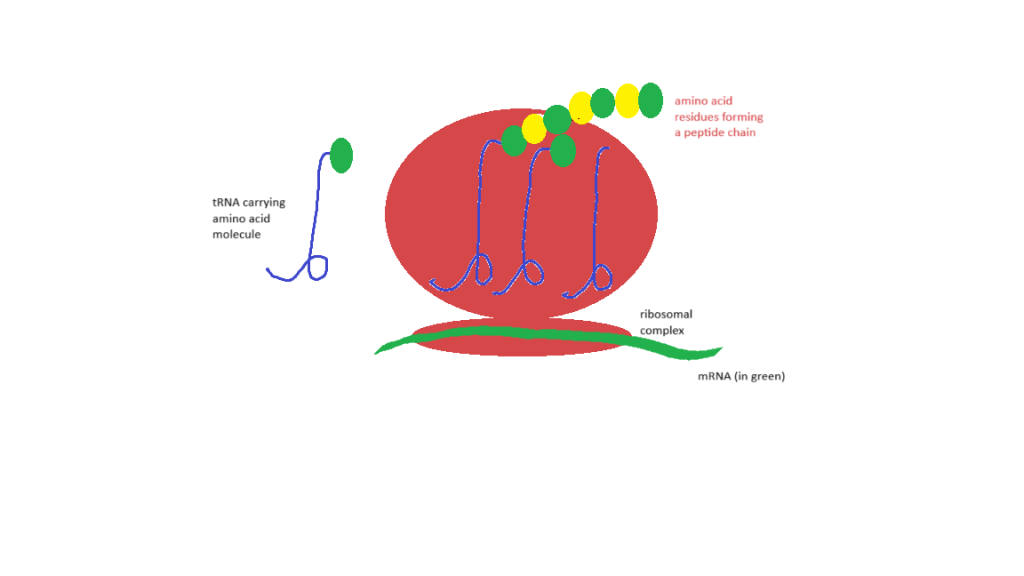
Cells contain various types of RNA. The messenger (m)RNA is the intermediate copy, the transfer (t)RNA brings the amino acids that make up the proteins to the ribosomal(r)RNA and protein complexes (ribosomes). In this way, proteins are created in the body. Apart from these there are other small RNA molecules like siRNA, snRNA, piRNA, tsRNA but that’s a story for another time. Here’s a rough sketch of what I mean-
The entire process of identifying RNA can be divided into three sections-
- Isolating the total RNA of cells or tissues.
- Converting RNA to cDNA.
- The RT-qPCR technique- Real time quantitative polymerase chain reaction.
Isolating RNA
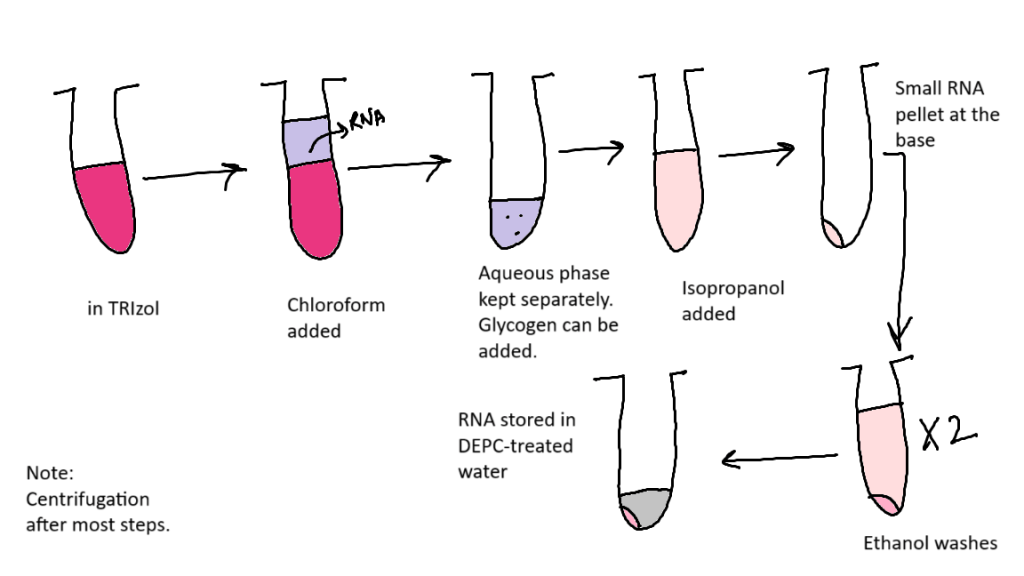
I have performed the manual method involving the phenol-chloroform RNA isolation. In this method-
- Keeping the cells in TRIzol (or Total RNA Isolation reagent). This contains phenol and a substance called guanidine isothiocynate (GTC) which disrupts the cells, dissolves any cellular components, maintains RNA integrity and essentially frees RNA from any proteins or other components that may hinder it’s purity or quality.
TRIzol also prevents any RNases or RNA-degrading enzymes from acting on the RNA. It can also be used when separating cytoplasmic RNA from nuclear RNA. - Using chloroform for “phase separation.”
Here is where chemistry meets biology. When chloroform is added to cells in TRIzol, the RNA is extracted into the top aqueous phase (chloroform) and proteins and other cellular components are present in the bottom organic phase (in TRIzol).
It’s a concept of “like dissolves like”, similar to why oil and water do not dissolve but alcohol and water do. Oil-organic, water-aqueous. - Precipitation of RNA using isopropanol.
Isopropyl alcohol or rubbing alcohol also precipitates RNA, forming a cloudy colored spot at the base of your tube. It removes the aqueous shield around the RNA made by the binding of water and the phosphate groups allowing the RNA to precipitate down instead of being dissolved in the chloroform (aqueous phase).
In this step, glycogen can be added in small quantities, used to recover very small quantities of RNA. It traps the RNA upon precipitation and allows for a more visible pellet. - 75% ethanol washes.
All impurities are then removed by ethanol washes. Usually performed twice, they remove any traces of TRIzol or other components which hinder the quality of RNA. - RNA is then stored in DEPC-treated water.
Diethyl pyrocarbonate or DEPC destroys any RNA-degrading enzymes or RNases by modifying some key components of the enzymes like the -NH2, -SH and -OH groups of amino acids. These groups are important components of the site that essentially degrades RNA. Once rendered useless, RNases cannot act on RNA.
Here’s a rough sketch of the process-
Converting RNA to cDNA
RNA is converted to cDNA using an enzyme called “reverse transcriptase.” Transcription is the process of converting DNA to RNA. The process is quite literally, transcribing a copy of DNA to RNA, hence the name. In this process, we are reversing that phenomenon- converting RNA to DNA. The reason for the “c” in cDNA, I will be explaining in another blog.
Most enzymes are named after the function they do- dehydrogenase: removes hydrogen molecule; hydrolase: cleaves something or breaks a bond, thereby releasing a water molecule; hydratase: just removes water (without breaking anything). Thus, reverse transcriptase (RT), reverses transcription.
In nature, even HIV does the same thing inside our cells. HIV has a copy of this enzyme and it converts the RNA copy of HIV into DNA which later integrates in human T-cell genome. In this way, HIV remains latent for a long time before the disease manifests itself. In the lab, one can use RT from avian myeloblastosis virus (AMV) or Moloney murine leukemia virus (MMLV).
AMV-RT was first discovered for cDNA synthesis in the lab but MMLV-RT is popular since its easier to produce in bacteria and can synthesize longer cDNA strands.
This step can also be avoided in a one-step RT-qPCR which only needs RNA.
Real time quantitative polymerase chain reaction
RT-qPCR. Lets break it down.
PCR or polymerase chain reaction is quite literally a chain reaction where the DNA amplifies exponentially from 1 to 2 to 4 to 8 to 16 and so on. This reaction also uses an enzyme called “DNA polymerase” that polymerizes the individual nucleic acids to create DNA strands.
RT is “real time” or “reverse transcription.” Real time is when this amplification is measured by the instrument as it occurs or that it measures the “q” or “quantity” of DNA as it is being made in the process.
A fluorescent dye is used such that when it binds to the specific DNA, in such a way that once the DNA gets amplified, a fluorescent signal is released that gets detected by the machine. In this way, based on the fluorescent signal, the DNA amplification is measured in real time or as it happens in the present.
Here’s a rough sketch of this reaction to understand better-

Where else has RT-qPCR been used?
This technique has been used in the COVID-19 detection kits, not the rapid ones, the ones where your nasal swab was taken and tested. The viral RNA was detected by this technique.
So what was the “Ct value” or the cycle threshold value that everyone talked about?
Say the instrument detects something at level 50 (hypothetically). If one already is at level 30, its easier (and faster) to reach level 50 but if one is at level 10, it will take more time to reach the same level.
Level 50 is the threshold level.
If someone has more viral particles (higher viral load), the threshold is achieved faster, the Ct value is lower (because it took less time, less DNA or RNA amplifications).
If someone has less viral particles (lower viral load), the threshold takes more time to achieve, the Ct value is higher (because it took more time, more DNA or RNA amplifications).
To summarize, a low Ct value will indicate more viral particles in the body. Hope that helps.
I have provided a very basic explanation of this process. For more information, please do visit the following websites-
- RNA isolation-
Toni, L. S., Garcia, A. M., Jeffrey, D. A., Jiang, X., Stauffer, B. L., Miyamoto, S. D., & Sucharov, C. C. (2018). Optimization of phenol-chloroform RNA extraction. MethodsX, 5, 599-608. doi: 10.1016/j.mex.2018.05.011 PMID: 29984193 - cDNA synthesis-
Thermo Fisher Scientific. Five Steps to Optimal cDNA Synthesis. Website. (Accessed on February 8, 2024). - RT-qPCR–
(a). Ho-Pun-Cheung, A., Bascoul-Mollevi, C., Assenat, E., Boissière-Michot, F., Bibeau, F., Cellier, D., … & Lopez-Crapez, E. (2009). Reverse transcription-quantitative polymerase chain reaction: description of a RIN-based algorithm for accurate data normalization. BMC molecular biology, 10, 1-10. doi: 10.1186/1471-2199-10-31 PMID: 19368728
(b). Clinicalsci. Real-Time PCR. Website. (Accessed on February 8, 2024)

 Ground breaking Grewall
Leave a comment