
I’m not a fan of these words.
In science, canonical is the general function or “rule” followed by a particular molecule.
Non-canonical, the opposite, is the deviation from the natural order.
For example, it is known that the cyclins and the cyclin-dependent kinases (CDKs) regulate the cell cycle. That is their canonical role. They regulate the cell cycle, checking if everything (DNA duplication, proteins, organelle division) is in order before each stage in the cell division.
(For a second there I was going to search for references online as to which paper tested this first, then I realized I’d be using Molecular Biology of the Gene by Watson as a reference before moving on to- this is my blog. I studied this in undergrad, I can say this. Nevertheless, the first-ever paper I can find currently that described the role of cyclins was in an article on yeast published in Nature.)
Some cancers show mutations in DNA repair pathways (eg. BRCA1 and BRCA2 which repair double-stranded DNA breaks in the genome. Their mutations are most commonly seen in breast cancer, among others) and also in cell cycle regulation.
If we can say that cancer consists of cells that divide uncontrollably, we can, by co-relation, test if the cell cycle regulators (cyclins and CDKs) are not functioning properly (and that has been reviewed in an article which was later also published in PMC).
One of the non-canonical role of cyclins and CDKs is their role in balancing cell death and proliferation. Overexpression of cyclin D1 has been observed in breast cancer and preventing fibrosarcoma cells from apoptosis or cell death but in some cases, if cyclin D1 expression is induced (induced when not generally present, or ectopic), such as in the case of some cell lines, it becomes toxic to the cells (cytotoxic), leading to cell death.
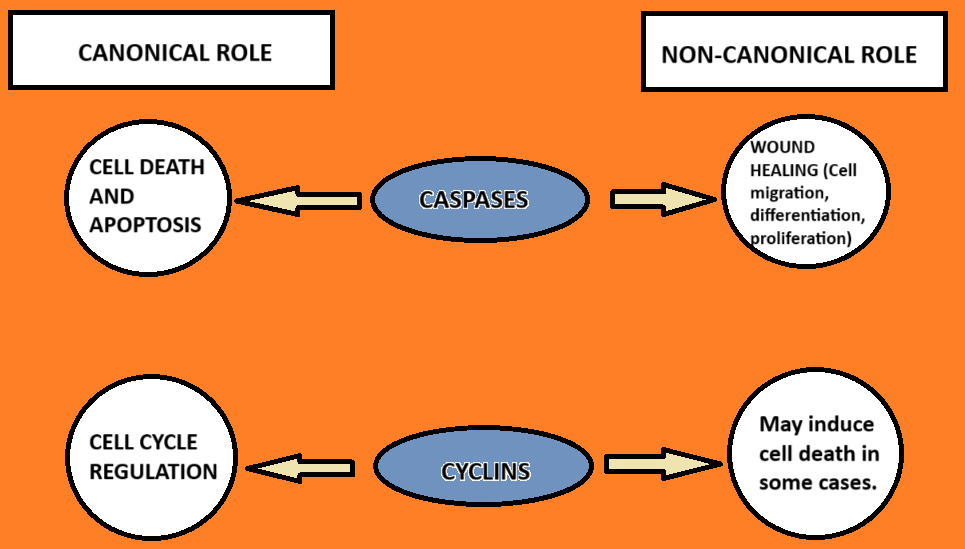
To some, it may seem obvious that cell division and cell death have some co-relation. Indeed, it is. But inside the cell, these are two different pathways and if the same molecule, binding to another, in one pathway, is also regulating by binding to another molecule in a different pathway, it’s considered as two different roles. So, not only is cyclin D1 majorly promoting cell division, it is also suppressing cell death. In pancreatic cancer cells, suppression of cyclin D1 led (made them sensitive) to apoptosis.
On the other hand, some studies showed that binding of cyclin D3 to caspase 2 (a protein involved in apoptosis) actually promoted cell death. This is an example of their non-canonical role.
I think the above is adequate to explain why I dislike the two terms.
Similarly, caspase-8, a molecule which plays a role in regulation of apoptosis may actually promote wound healing. The canonical and non-canonical.
This makes me wonder if, just because scientists established the role of a molecule in a certain cellular pathway first, that became the “canonical” role and other roles were established later which came to be known as “non-canonical.”
To that, one can argue, as in the case of caspase, these proteins (consisting of caspase-1, caspase-3, caspase-7, caspase-8, caspase-9 and so on), belonging to a group of similar proteins (they are all cysteine-aspartic proteases) had a role in the same pathway (cell death) while only a few of them are involved in different roles. Thus, differentiating the canonical and non-canonical roles.
But even so, what if their property “cysteine-aspartic protease” which means that they have an active site consisting of cysteines for cleaving amino-acid residues after aspartate was required in different pathways. Same function, but just required at different roles in the cell. So which is canonical and the non-canonical.
And so, the spiral begins.
Maybe that is why, to keep it simple, scientists put similar molecules, with similar functions and roles in the same pathway and named it “canonical” role and kept the rest, the roles which are still being tested and discovered, as the “non-canonical”.
***
Thank you for listening to my rant. I apologize for confusing the audience, if at all. This topic has been on my mind from time-to-time since I work in the “non-canonical” role of some proteins. It also may be a bit of a bigger pill than the rest of my articles.
***
Last week, I had written about extracellular DNA. Nature has published an article on volunteers and scientists collecting Lake eDNA to understand the species living in and alongside the lake, highlighting the importance of such events at a global scale to study biodiversity.

 Ground breaking Grewall
Leave a comment