
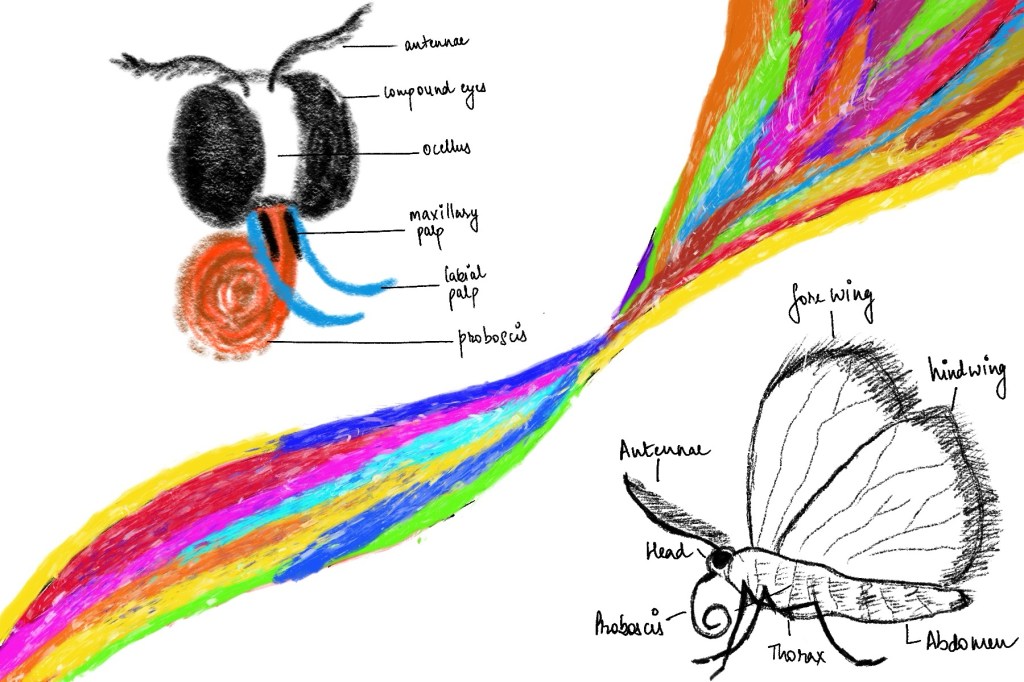
This month, I am in the NIB (Neuro-mechanics of Insect Behaviour) Lab. While I’m still figuring the “big question”, the last week has been a fascinating journey. I learnt about hawkmoth brain.
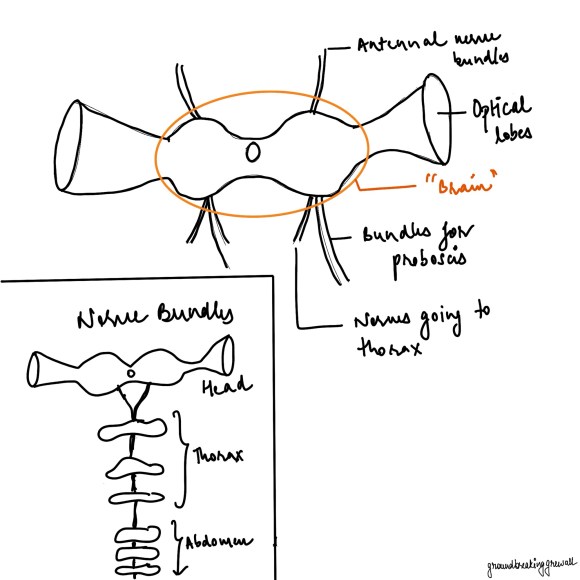
Yeah, I know. Insects do not have “brains”, they have these nerve bundles that run along through many segments of their body. Each bundle branches out further to reach the “organs” of their tiny bodies. For example, in the thorax, the bundles branch out into wings. In the diagram below, I have briefly mentioned the neuronal bundles in the head.
First question: Why do people study Hawk moths?
Bees help in understanding some psychiatric behaviours like social anxiety, houseflies were used to study genetics and inheritance. We could learn about linked inheritance from Drosophila.
Hawkmoths are used to study pollination patterns and how pollination affects plant populations. These insects belong to an order or group called “Lepidoptera” which also includes butterflies. They are characterized with having two pairs of wings with scales and are second largest insects in size after beetles.
They are mostly nocturnal (commonly Manduca sexta but diurnal moths like Macroglossum stellatarum or the hummingbird hawkmoth are also present) and have also been called the “underdogs” of the pollinators. Most of their activities occur at night and they can travel almost 18 miles while feeding on nectar on their path.
What have I learnt so far-
- Insects have different cues from the environment. Till now, I have come across three cues- visual, olfactory or mechanosensory (tactile or touch). It is debatable which is most essential, and I’ve come to realize they’re all important in their own way (this should have been obvious to me since I can’t really say eyes are more important than the nose).
- Visual cues are received by their compound eyes.
Odour cues are received by their antennae. Since hawkmoths are nocturnal, they rely more on odour than vision (like bats, which are also pollinators).
Mechanosensory-activation cues are present in a couple of places- at the Bohm’s Bristles and Johnston’s organ at the base of the antennae which help in flight control. Some sensors near the base of the proboscis help to maintain the hovering motion with respect to the movement of the flower. - Odour or olfactory cues help in long distance travel (towards nectar) and they’re what I consider “slow” cues because they’re all around the moth as the they move through a gradient. Visual cues are faster- they help the moth change direction or move quickly.
- Moths have trichromatic colour vision – UV, blue and green. For perspective, humans also have trichromatic vision – blue, green and red and most colours are a combination of either of these three photoreceptors (cones) sensing these wavelengths. For now, I am not sure whether moths can detect long wavelength (eg. red).
From what I understand,
Moths hover around the flower –> flowers move due to the wind –> moths sense that by their sensory and visual neurons –> signal sent to the motor neurons –> signal the muscles of the proboscis or the wings –> move according to the flower to be able to feed on nectar.
Flight patterns in hawkmoths are also being studied which can help navigate the production of better aeronautics.
References:
Anna Stöckl, Tanvi Deora, The Hawkmoth Proboscis: An Insect Model for Sensorimotor Control of Reaching and Exploration, Integrative and Comparative Biology, 2024;, icae123, https://doi.org/10.1093/icb/icae123

 Ground breaking Grewall
Leave a comment