
DNA?
The genetic material that makes up the entire human body? Animals? Plants? Nature?
Not present inside the cell?
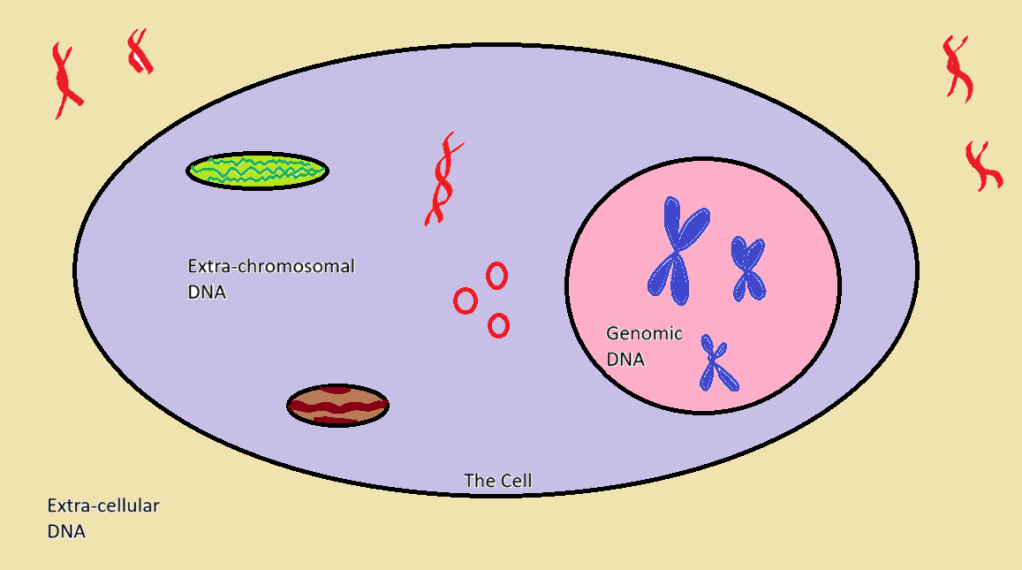
3 types of DNA (based on their location)
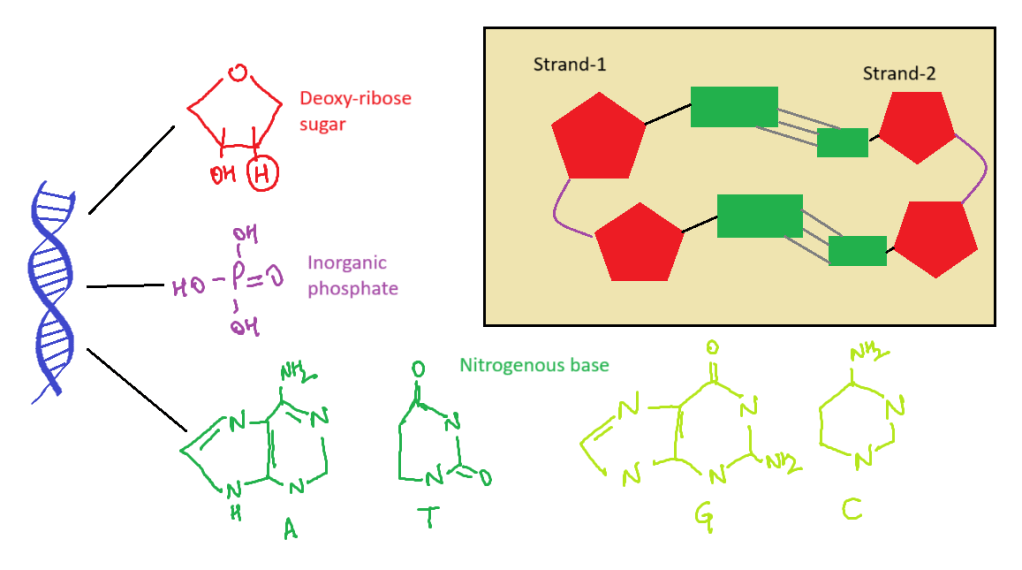
DNA is. De-oxy-ribo-nucleic acid. Using the rough diagram as a reference, it’s made up of three components- a sugar moiety, phosphate groups (eat your bananas) and nitrogenous bases (chemistry’s quite literally in your DNA).
There are two strands of DNA, joined together by hydrogen bonds (the grey lines between the green rectangles).
Cell is the basic, functional unit of life?
No. It’s carbon, hydrogen and oxygen.
Technically yes, because these molecules cannot function independently and need other components, but even those components are made up of the same elements (mostly).
The DNA present inside the nucleus of the cell is called genomic DNA. Chromosomes are made up of genomic DNA.
Bacteria or prokaryotes do not have compartments like nucleus in the cell. They usually have one big “chromosome” or genomic DNA. Eukaryotes, like us, have compartments in the cell such as the nucleus or Golgi bodies, endoplasmic reticulum (ER) and such. Eukaryotes can have multiple “chromosomes.”
Some examples are mitochondrial DNA (in animals) and chloroplast DNA (in plants).
The DNA present inside the nucleus of the cell is called genomic DNA. Chromosomes are made up of genomic DNA.
Then there’s extra-chromosomal DNA– the one that is present inside the cell but not a part of what we can consider “genomic DNA.”
Bacteria or prokaryotes do not have compartments like nucleus in the cell. They usually have one big “chromosome” or genomic DNA. Eukaryotes, like us, have compartments in the cell such as the nucleus or Golgi bodies, endoplasmic reticulum (ER) and such. Eukaryotes can have multiple “chromosomes.”
Some examples are mitochondrial DNA (in animals) and chloroplast DNA (in plants).
What are “chromosomes” and “genome”?
Chromosomes are highly organized structures made up of DNA. Genome comprises of all the chromosomes in the nucleus of the cell. The human genome is almost 3 meters long, while an average human cell is around 20-30 micrometers. For that much DNA to fit inside the nucleus, it needs to be folded into chromosomes.
DNA appear as thread-like structures but when folded, they look more globular, like the blue structures shown in the rough diagram.
Bacteria also have DNA in the form of plasmids. There can be two or more types of plasmids and also multiple copies of the same plasmid. Plasmids contain some genes which aid the bacteria by kill other bacteria (col plasmids), by providing resistance against antibiotics (resistance plasmids) or by forming “sex pilli” by which two bacteria can exchange DNA or genetic material.
There are plasmids that can degrade some special materials like plastics or substance which are not a regular part of metabolism. Bacteria which have such plasmids have been used for bioremediation [1, 2].
Some bacteria, such as Bacillus subtilis is used for experimental work, but its sister species, Bacillus anthracis causes a disease called anthrax. These can be due to the presence of certain genes that make a bacteria dieases-causing or pathogenic- extra-chromosomal genes in virulence plasmids.
Thus, one can define plasmids as some extra genes that are not necessary for the survival of bacteria, but having them is advantageous.
Lastly, there’s extra-cellular DNA or DNA present outside the cell.
Neutrophils, a type of white blood cell that helps us fight infections by “eating up” bacteria and viruses, also secrete DNA, in the form of “NETs” or neutrophil extracellular traps, during inflammation. This captures the pathogens, potentially killing them and prevents the spread of infection to other parts of the body. It is a suicidal, last-resort plan by the immune cell. There is yet more research needed to be conducted on “NETs” and the condition in which they are formed. Yet, it is quite an interesting phenomenon [3].
Extracellular or cell-free DNA (exDNA or cfDNA) is also randomly present in nature- in soil and water bodies. There is research which believes that exDNA is actively secreted.
This has been used to study the environment, the flora and fauna and the microenvironment, the bacterial or fungal species which was or is present, as a way to understand the biodiversity of a place [4].
In some cases, they also aid in forming bacterial biofilms (biofilm- a community of same or different bacteria which live closely inside a protected barrier). In a way, one can look at it as a way that bacteria communicate with or feel out other bacteria in their vicinity [5].
There is a comprehensive and beautiful review on exDNA in different marine habitats which discusses their origin, production, decay, preservation, limitations and uses for those who would really enjoy an extensive read. I’ll attach the DOI link here.
Hope you all found the article as interesting as I did while reading about this topic. My goal is to make science easily understandable and accessible to all. Please do let me know in the comments if there is something you’d like to know about related to biology or biotechnology.
For further reading,
- Yoshida, S., Hiraga, K., Takehana, T., Taniguchi, I., Yamaji, H., Maeda, Y., … & Oda, K. (2016). A bacterium that degrades and assimilates poly (ethylene terephthalate). Science, 351(6278), 1196-1199. DOI: 10.1126/science.aad6359
- Saini, P., Grewall, A., & Hooda, S. (2023). In silico approach for identification of polyethylene terephthalate hydrolase (PETase)-like enzymes. Bioremediation Journal, 27(3), 311-323.
DOI: 10.1080/10889868.2022.2054931 - Dömer, D., Walther, T., Möller, S., Behnen, M., & Laskay, T. (2021). Neutrophil extracellular traps activate proinflammatory functions of human neutrophils. Frontiers in immunology, 12, 636954.
DOI: 10.3389/fimmu.2021.636954 - Nagler, M., Insam, H., Pietramellara, G., & Ascher-Jenull, J. (2018). Extracellular DNA in natural environments: features, relevance and applications. Applied microbiology and biotechnology, 102, 6343-6356. DOI: 10.1007/s00253-018-9120-4
- Panlilio, H., & Rice, C. V. (2021). The role of extracellular DNA in the formation, architecture, stability, and treatment of bacterial biofilms. Biotechnology and bioengineering, 118(6), 2129-2141. DOI: 10.1002/bit.27760


 Ground breaking Grewall
Leave a reply to ananyagrewall Cancel reply